leading
a movement
transformational community
what will it take?
by mike tilley
God is raising up a network of student-led, staff-coached
Campus Crusade for Christ ministries at colleges across
the U.S. Campus Crusade is working to help leaders like
you build movements that will transform their campuses
and make an impact around the world.
Our desire is to develop a ministry,
on every campus, that is not merely a club but rather
a transformational community. We envision a community
where:
-
lost students are being transformed
by the gospel of Christ (Colossians 1:13-14)
-
where Christians are being transformed
in 'grace and truth relationships' (Ephesians
4)
-
where the campus and world are being transformed
by laborers who are sent
(Matt. 9:37-39)
Acts 2:42-47 describes the first transformational
community
-
Everyone felt a sense of awe because they
saw God at work
-
Believers were devoted
to biblical teaching, prayer, and real koininia
(fellowship)
-
And God was adding to
their number daily those who were being
saved
That first community was a true movement of God's Spirit.
That is the kind of movement we are trusting God
to create on every campus. While a core or cell
group is the foundation for such a movement, we'd like
to see it grow to a size of 50 or more students. And
when God moves, we often see that He uses students to
reach students.
In the summer of 1996, the Atlanta Summer Project launched
the ministry at Kennesaw State University, a
commuter campus in Atlanta.
Three years later:
- You would have seen 150 students at the
(completely student-led) weekly meeting at noon on
any given Thursday
- Several students who first came to know Christ
at Kennesaw State now held leadership positions.
- As part of the Atlanta Metro movement, these students
were not only transforming their campus, they were
influencing the city, with a view towards the
world.
- And they had the opportunity to go to the world,
through Atlanta's Worldwide Student Network (WSN)
partnership.
What
Is Your Dream?
As you look at your campus, ask
yourself these questions:
- "What would I like to
see God do here?
- "What is my dream?"
If you don't know the answer yet, it's OK. God will
show you His desire for your campus as you continue
to trust Him.
Vision develops and deepens as students like you
pray and dream together, and reach out to others on
campus. There is room to fill in the specifics of
your vision over time to reflect the character and flavor
of your unique campus.
What Is the Campus Like?
Another
important question to ask is, "What are students
like on my campus?" Kennesaw State had its weekly
meeting during the lunch hour. This works best because
its a commuter campus. Most campuses are so multifaceted
that many transformational communities will be needed
to reach them.
Ask
yourself these questions about your campus:
- What is the level of spiritual interest?
- What keys will open doors for the gospel?
- What is the ethnic diversity on campus?
- What do people do for fun?
Answering these questions will help you tailor-make
your ministry to your campus.
Who Are the Leaders?
A
third question that must be answered is, "Who will lead
the effort on campus?" Within five miles of every
campus, we believe God has already placed the people
and resources to reach that campus for Christ. We
want to discover who that person is and help that key
leader gather the essentials needed to get started.
This is called assembling critical mass. In Mark 4,
Jesus talked about the small mustard seed, which, when
planted, grew into a huge tree. Critical mass is like
the seed; it contains all the future elements needed
to build a transformational community.
How do you know if you have critical mass on a campus?
One
Campus Crusade metro director believes you have
achieved critical mass on your campus when four things
are in place:
- aligned leaders
- the mustard seed of community
- prevailing prayer
- students engaging the lost
In some cases, the best way to assemble critical mass
is to partner with a church or lay volunteer. Whether
you start with a key student (like yourself) or partnering
church, you do not have critical mass unless a core
group of students is poised to reach the campus.
How
Do We Go from 10 to 50?
Ask
yourself, "How will I go about it? What will it
take to turn my dreams into reality?" There are
at least four critical path steps for building a community
to transform your campus for Christ.
Acrobat
pdf Version of Critical Path Diagram

Prayer
In
Colossians 4:2, Paul encourages the believers to "devote
yourselves to prayer." We are engaged in spiritual warfare,
and prayer is critical. E.M. Bounds wrote there could
be no devotion without prayer, and no prayer without
devotion. A passion for God and His work is born
in prayer.
Be
creative here. Plan a Jericho walk where you walk
around the campus seven times praying that God will
cause the spiritual strongholds to come down. (Different
variations of this can be applied to your campus. Read
Joshua 5:13-6:21.)
Other
suggestions:
- You might try morning prayer meetings
- Prayer in cell groups
- You might want to contact local churches to ask
them to pray for your campus.
In any event, prayer is essential for the advancement
of the kingdom.
Evangelism
Powerful
biblical motivations for evangelism are found
in Luke 15:1-6 and Colossians 4:2-6. It is to find ways
of doing evangelism that are both effective and student-friendly.
We
need to unleash the power of the believers' witness
in natural relationships.
You have a natural network with students in
- classes
- clubs
- fraternities
- sororities
- with students you meet where you live
- and other places.
Your network of these friends, as well as family, neighbors
and co-workers provides the most natural and potentially
powerful context for evangelism.
You
can also move well outside of your relational networks
by using simple tools such as freshman surveys, which
enable you to 'cast a big net' and gather critical mass
(Christians) as well as spiritual seekers. Implementing
a freshman strategy will enable you to build the base
for a future transformational community.
Beyond
that, you can literally expose the entire campus
to the message of Christ through broad sowing strategies
such as Freshman Survival Kits (a giveaway of quality
materials presenting Christ in multiple ways) and Every
Student's Choice (media campaigns on significant campus
issues).
Several
years ago, a student in Boston named Steve Sawyer
was led to Christ by a guy who got involved in the ministry
through a poster campaign at a campus with no Crusade
staff. Even though he had AIDS, Steve traveled to campuses
around the world, sharing Christ with large audiences.
When he died in 1999, he had led thousands of students
to Christ. And all of that started with a poster.
Discipleship
Building
transformational community requires more than just prayer
and evangelism; it requires the spiritual growth and
discipleship of both new and mature believers. At times,
our view of discipleship is mistakenly limited to only
using a one-on-one approach. However, much of the
New Testament describes life change happening in the
context of relationships and biblical community
(Ephesians 4; Colossians 3:12-17). God uses a variety
of means to transform a life, and this often occurs
in small groups where there is an environment of grace
and truth.
In
a student-led cell group:
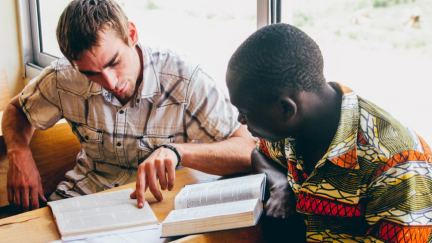
- believers can study the Bible
- pray together
- experience biblical fellowship
- be trained for outreach.
The cell group should also be committed to church involvement.
Training and vision can also happen as you bring students
with you to retreats, conferences, and summer
projects.
With
the growth of the Internet, you, as a student leader,
have immediate access to a wide range of discipleship
resources. For example, a student anywhere in the world
can download copy-ready Bible study from this Web site.
In
addition to the church, cell groups, and online resources,
student leaders can seek personalized discipleship
from a Campus Crusade staff member. If that's not
possible in person, then students can receive discipleship
over the phone by contacting the Student LINC (Leaders
in New Campus) ministry, in Orlando.
Sending
In
Matthew 9:37, Jesus said, "The harvest is plentiful
but the workers are few." He went on to say that we
need to ask the Lord of the harvest to send out workers.
College
students like you can be used by God to change the world.
A global culture of common technology, mobility, and
even language makes this a time of great urgency and
potential for the worldwide spread of the gospel. Student-led
ministries often send laborers into the harvest. They
are part of a growing movement of students who want
to follow Christ wherever He leads.
At
the 1997 Indianapolis Christmas Conference, more than
700 students signed the Millennial Pledge, a
commitment to God to serve at least one year as a missionary
between now and the end of this century. At the Northeast
Winter Conference in Springfield, MA, 120 students signed
the pledge. More than 1,500 students nationwide
have signed the Millennial Pledge so far.
With
the increased opportunities available through one-year
internships students now have more options to serve
Christ and investigate using their skills in full-time
ministry after college.
In
Philadelphia, one staff member is taking students on
a two-week mission trip to Spain to distribute
the "JESUS" film. Students from the Portland Metro ministry
joined with a local church to serve free coffee at the
Nagano Olympics. Of course, their purpose was
to share Christ with everyone they could, not just to
serve coffee.
Student
LINC has proven the effectiveness of long-distance
ministry over the years. Their student-led ministries
typically make a strong showing at Christmas conferences
and The Big Break. And many of these students are now
entering the mission field by joining the full-time
staff of Campus Crusade due in part to the effectiveness
of Student LINC.
In
the summer of 1998, the Worldwide Student Network
sponsored 74 projects to various parts of the world.
As metro ministries and other Catalytic ministries mature,
the growth of summer projects and STINT (a one-year
mission overseas) will be dramatic.
Its happening now!
Through
the pioneering efforts of metro teams, church partners,
Student LINC, and other field Catalytic staff, student-led
ministries have been planted on hundreds of campuses
since 1992. Still there are hundreds of unreached
campuses where we believe God has the resources in place
to reach a campus.
Our dream is a student-led ministry
team, not only for every campus, but also for every
group on every campus.
As we trust God to raise up leaders such as you, and
as we help you develop transformational community,
we can imagine a day when every
student will have the chance to be transformed by Jesus
Christ.
For
Further Thought
1.
What are the three components of a Transformational
Community? How would you describe each component
in your own words?
2.
What do we want to see God do on our campus?
- What do you want to see God do on
your campus?
- "What is my Dream?
....vision
develops and deepens as students like you pray and dream
together, and reach out to others on campus.
3.
What is our campus like?
Ask yourself these questions about your campus:
- What is the level of spiritual interest?
- What keys will open doors for the
gospel?
- What is the ethnic diversity on
campus?
- What do people do for fun?
Answering
these questions will help you tailor-make your ministry
to your campus.
4.
Who is going to lead this effort to tranform our campus?
"Who
will lead the effort on campus?" Within five miles of
every campus, we believe God has already placed the
people and resources to reach that campus for Christ.
We want to discover who that person is and help that
key leader gather the essentials needed to get started.
This is called assembling critical mass."
5.
Do we have critical mass yet for our campus? If not,
what do we need to do to get it?
One
Campus Crusade metro director believes you have achieved
critical mass on your campus when four things are in
place: · aligned leaders · the mustard seed of community
· prevailing prayer · students engaging the lost In
some cases, the best way to assemble critical mass is
to partner with a church or lay volunteer. Whether you
start with a key student (like yourself) or partnering
church, you do not have critical mass unless a core
group of students is poised to reach the campus.
6.
What are the next appropriate steps to take in our ministry
in the areas of:
- Prayer
- Evangelism
- Discipleship
- Sending
From
the article:
Prayer: "A passion for God and His work is born
in prayer. Be creative here."
Evangelism: "Powerful biblical motivations
for evangelism are found in Luke 15:1-6 and Colossians
4:2-6. It is to find ways of doing evangelism that are
both effective and student-friendly.
We need to unleash the power of the believers' witness
in natural relationships. You have a natural network
with students in:
- classes
- clubs
- fraternities
- sororities
- with students you meet where you
live
- and other places.
Your
network of these friends, as well as family, neighbors
and co-workers provides the most natural and potentially
powerful context for evangelism.
You
can also move well outside of your relational networks
by using simple tools such as freshman surveys, which
enable you to 'cast a big net' and gather critical mass
(Christians) as well as spiritual seekers. Implementing
a freshman strategy will enable you to build the base
for a future transformational community."
Discipleship:
"In a student-led cell group:
- believers can study the Bible
- pray together
- experience biblical fellowship
- be trained for outreach.
The
cell group should also be committed to church involvement.
Training and vision can also happen as you bring students
with you to retreats, conferences, and summer projects.
With the growth of the Internet, you, as a student leader,
have immediate access to a wide range of discipleship
resources."
Sending:
"In Matthew 9:37, Jesus said, "The harvest is
plentiful but the workers are few." He went on to say
that we need to ask the Lord of the harvest to send
out workers.
College students like you can be used by God to
change the world. A global culture of common technology,
mobility, and even language makes this a time of great
urgency and potential for the worldwide spread of the
gospel. Student-led ministries often send laborers into
the harvest. Finish the study by reviewing the highlights
of the article and discussing specific action points
to take."
|